
The Garmin Connect SDK was meant to be a practical tool for my own data. Recently it started getting the nicest kind of signal: questions from people trying it, interest from people who want to build on it, and thank-you messages from people who already do. Not a mass movement. Just enough real people to make the project feel less like a private drawer.
The reason is not mysterious. Garmin has a large developer community, but there is still no public consumer API for the ordinary “I own this data and would like to read it” use case. Garmin has an official Connect Developer Program, but it is aimed at approved business and platform integrations. That leaves personal developers looking at the same data through a much narrower door.
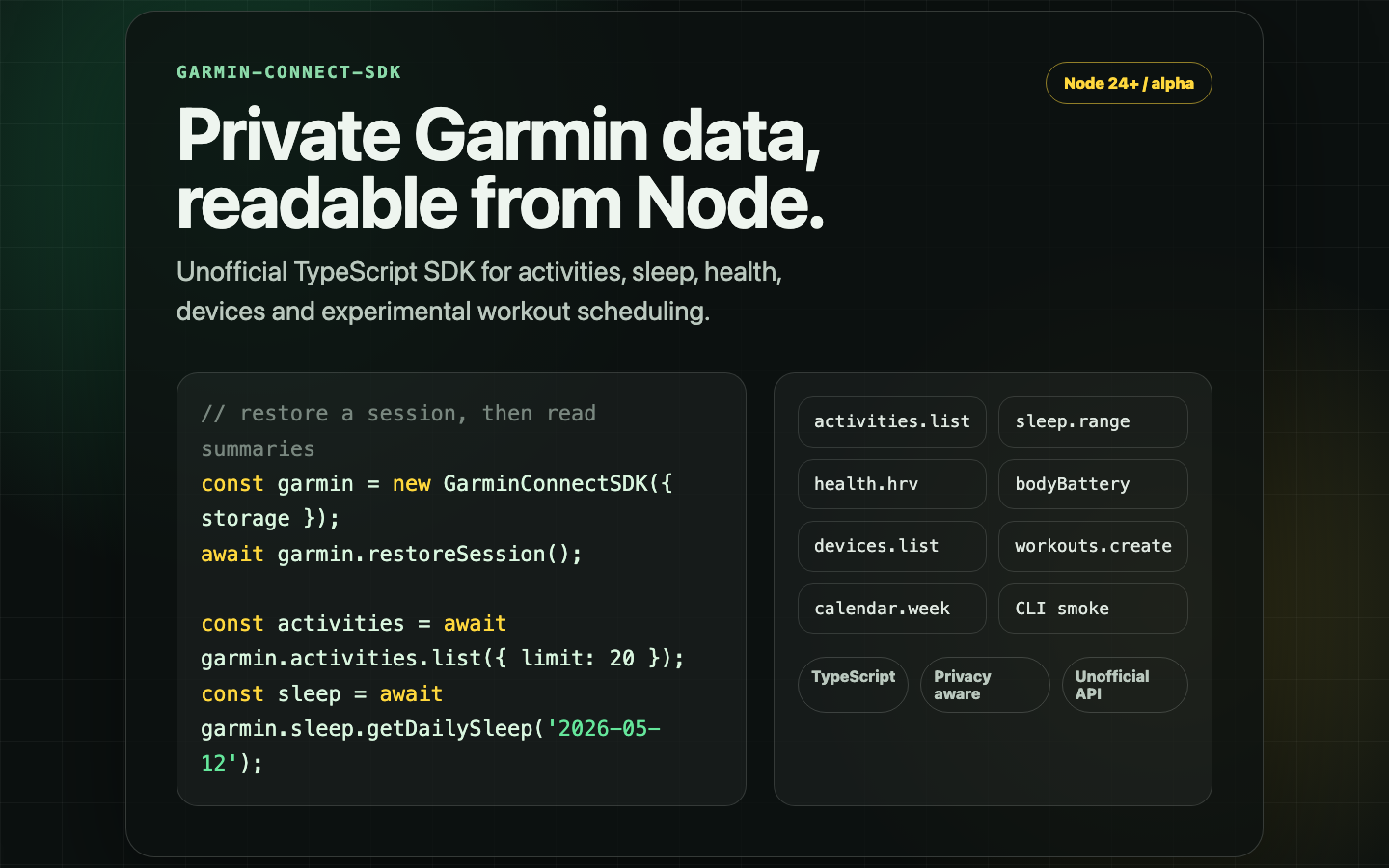
The SDK uses the unofficial route. It is a TypeScript wrapper around the parts of Garmin Connect I need: activities, sleep, health metrics, devices and a few experimental scheduling ideas. It is read-first because writing data is a different risk category. It is conservative because private endpoints change, rate limits are not a product promise, and a login flow is not a licence to pretend the service is yours.
The community response is useful evidence, but it is not permission to oversell the project. A few people saying “this helped” does not mean the SDK is stable forever, officially supported or suitable for every production system. It means the missing public surface is real enough that people are willing to work around it.
That puts a responsibility on the maintainer. Keep the scope clear. Do not print credentials in examples. Do not collect somebody else’s health data because a demo made it easy. Do not turn a private endpoint into a confident promise about tomorrow. Document what the SDK reads, what it does not write, and where Garmin can change the floor underneath it.
I would still prefer an official consumer API. It would be safer for users, calmer for maintainers and better for the ecosystem. Until then, useful unofficial tooling can exist, as long as it stays honest about the floor it stands on.
For now the best signal is simple: people are using it and asking sensible questions. That is enough reason to keep improving the boundary, the docs and the failure messages. It is not a reason to call a private API stable. Garmin can keep that particular mystery.