
A lot of operations work still runs on tribal memory and screenshot folklore. Someone remembers why a restart happened. Someone else thinks a risk was accepted last month. Then production asks for proof and the team starts digging through chat history.
That is the gap Console is trying to close. It gives operators one place to see governance evidence, pending approvals, policy exceptions and fleet signals without pretending a dashboard equals control.
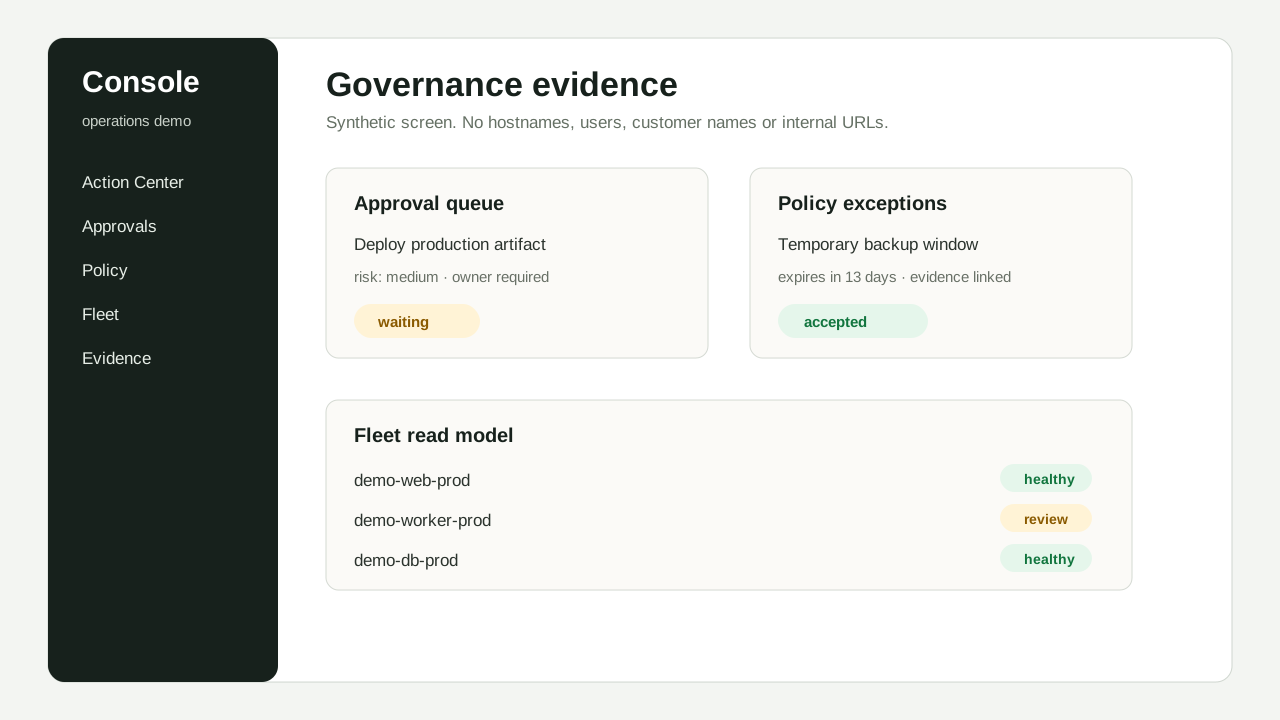
The useful split in the model is simple. Inventory stays operator-owned. Telemetry stays observed. If a collector goes stale, the system should not forget the server exists. If deployment evidence is incomplete, the system should say “unknown” instead of making up confidence with a straight face.
The governance view pulls a few stubborn truths into one list. Open deviations. Accepted policy exceptions. Waiting approvals. Stale collectors. Missing backup confidence. Incomplete deployment confidence. That sounds dry because it is dry. Dry is good here. Dry means you can point to a record instead of starting a debate.
Policy exceptions need a hard edge. Console treats them like temporary risk decisions, not magic erasers. A requester cannot approve their own exception. An exception needs an expiry date or review date. If the exception expires, the finding comes back as a finding. That shape beats the “temporary” waiver that survives long enough to need its own maintenance plan.
The approval side follows the same idea. Read-only work can stay inside the Console boundary. Refresh, sync and report jobs can run as bounded requests. State-changing work needs explicit approval with reason and target context. Destructive shell-shaped heroics stay out of scope. An ops console should lower chaos, not hand out a prettier flame button.
The action lifecycle also matters. Request. Approve or reject. Expire if nobody acts. Record the result after execution. Approval proves that a human allowed a bounded action to proceed. Approval does not prove that the action ran, and it does not prove that it worked. Systems should say those are different things because they are.
The runtime and fleet side makes the governance story less abstract. Collector freshness, backup confidence and deployment state feed the same operator picture. If a host collector stops talking, that becomes evidence. If backup confidence drops, that becomes evidence. If deployment truth looks mixed across targets, that becomes evidence too. You stop juggling five tabs and one suspicious memory.
This is where standards stop being PDF wallpaper. ISO 27001 cares about managed risk, reviewable controls and evidence that survives staff memory. The OWASP Logging Cheat Sheet keeps repeating the same lesson from another angle: log decisions and failures in a way operators can trust. GitHub deployment reviews already apply that posture to releases.
I like this direction because it stays boring in the right places. No arbitrary shell box in the web UI. No “trust me” exception flow. No fake certainty when telemetry is stale. A cleaner chain from signal to approval to evidence to follow-up leaves less room for theatre.